The Best AI Strategy Is 200 Years Old
We just keep forgetting.
Big new technology always follows the same path. Huge promise, a gold rush, then the slow realisation that the tech was never the hard part. Changing how people work with it was.
This pattern has repeated with remarkable consistency since the first Industrial Revolution. And understanding it is the single most useful thing any organisation can do right now when it comes to AI.
Why AI Adoption Follows the Same Pattern as Every Technology Before It
In 1712, Thomas Newcomen, a man most people have never heard of, created a steam engine to pump water out of tin mines in South Devon. Around fifty years later, James Watt evolved it into something efficient and cheap to run. Combined with advances in mechanical engineering, chemistry, and metallurgy, this triggered what we now call the Industrial Revolution.1
The impact was staggering. In his work The Measure of Civilization, the archaeologist Ian Morris mapped human social development from 14,000 BCE to the present. For most of that period, the line is flat. Then, with the advent of the steam engine and fossil fuels, it goes almost vertical.2
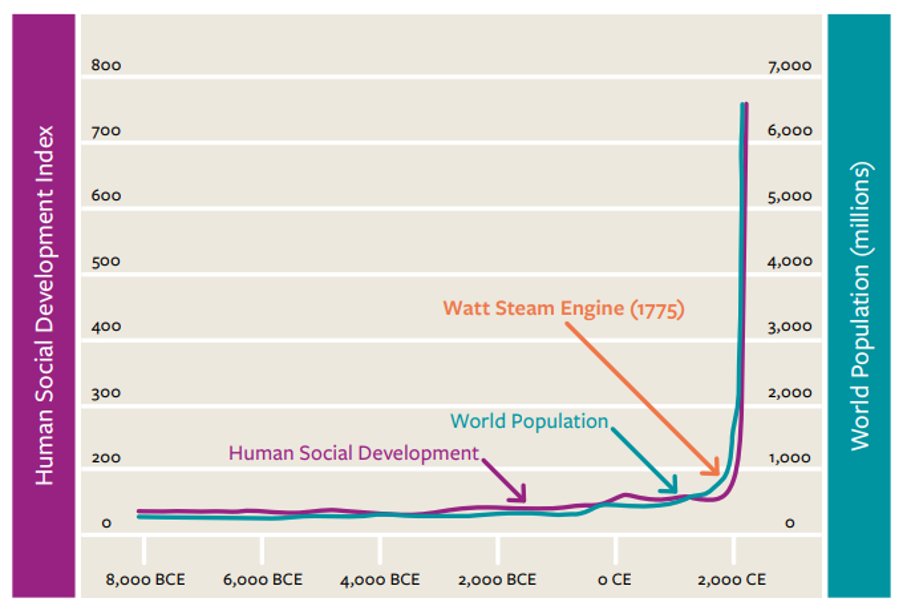
But here's what the hockey stick doesn't show: the decades of painful adaptation between the technology arriving and the productivity gains materialising. The factory owners who adopted steam fastest assumed they'd won. Many hadn't. They installed engines in buildings designed for water power, kept the same workflows, and wondered why output didn't leap. It took decades of experimentation with factory layout, worker training, and management practices before steam delivered on its promise.
The economist Paul David documented this phenomenon in a landmark 1990 paper, showing that electrification followed a strikingly similar pattern, with a lag of twenty to thirty years between adoption and measurable economic impact.3 When factories first electrified in the 1890s, they simply replaced their central steam engine with a central electric motor, keeping the same belt-and-shaft system. It wasn't until manufacturers redesigned their entire production lines around distributed motors, each machine with its own power source, that productivity surged. The technology arrived in the 1890s. The gains didn't fully materialise until the 1920s.
The internet and cloud computing compressed the timeline but followed the same arc. Companies rushed to build websites in the late 1990s, many of them digital brochures that added cost without changing how the business actually worked. Cloud migration in the 2010s saw the same dynamic: organisations that "lifted and shifted" their existing systems gained little, while those that rethought their architecture and processes saw genuine transformation.
Every time, the organisations that thrived weren't the fastest adopters. They were the most effective adaptors. The fastest learners.
AI as a General Purpose Technology
Economists have a term for technologies like steam, electricity, and computing: General Purpose Technologies (GPTs). These are innovations so fundamental that they reshape entire economies and societies, not just individual industries. They share a common trait: the time between invention and full economic impact is measured in decades, not years.4
AI is a General Purpose Technology. So, arguably, are synthetic biology and quantum computing, which are developing alongside it. The futurist Frank Diana makes the point that unlike previous GPT cycles, which were largely driven by a single foundational technology, today's breakthroughs are converging and reinforcing each other. AI is enabling quantum advancements, which in turn accelerate materials science and biological innovation.5
Diana also notes something that could make this cycle faster than previous ones: the digital infrastructure already exists. Unlike electricity, which required the construction of power grids, or computing, which relied on decades of hardware evolution, AI builds on mature cloud computing, global data networks, and digital platforms that are already in place. AI applications can be deployed over the internet. That eliminates one of the biggest historical barriers to diffusion.
But here's the tension. The technology may diffuse faster, but human adaptability doesn't speed up at the same rate.
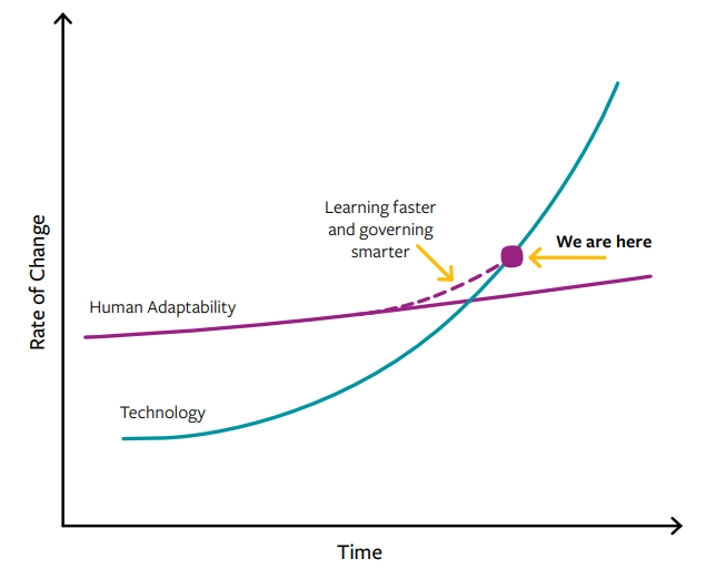
This diagram captures the fundamental challenge. The teal curve (technology) is accelerating exponentially. The purple line (human adaptability) moves in a steadier, more linear way. We've now reached the crossover point where technology is changing faster than our organisations, regulations, and people can comfortably keep up.
The response to this gap is not to slow down the technology (that's neither possible nor desirable) or to pretend humans can suddenly adapt faster (that's naive). The response is to adopt approaches that are specifically designed for navigating uncertainty and complexity at speed.
Which is exactly what agile was built for.
AI Adoption Is No Different, but the Stakes Are Higher
Even Sam Altman now concedes that scaling alone won't be enough, that new architectures are needed.6 You can only hide from reality for so long. This is a significant retreat from his claim just fourteen months earlier that "we now know how to build AGI as it's usually understood." Taken alongside similar concessions from Demis Hassabis at Google DeepMind, Ilya Sutskever (formerly OpenAI), and Yann LeCun at Meta, the shift is clear: the insiders are acknowledging what the evidence has been showing for a while.7
Diana's three scenarios for this GPT cycle are worth considering. In the optimistic scenario, converging technologies and existing infrastructure compress the transition to 15 years rather than 50. In the cautious scenario, regulation, workforce adaptation, and institutional inertia slow things to the historical pattern of 20+ years. In the concerning scenario, adoption happens asymmetrically, with some nations and organisations racing ahead while others deliberate.5
The honest answer is probably a mix of all three. Some industries will move fast. Others will lag. And the gap between organisations that adopt AI empirically and those that either rush blindly or hesitate indefinitely will widen.
The AI Capability-Reliability Gap
A research paper from Princeton and Stanford, published in February 2026, puts numbers to something that anyone working with AI tools will recognise: capabilities have surged, but reliability hasn't kept pace.8
The paper, "Towards a Science of AI Agent Reliability," examined 14 agentic AI models across two benchmarks over 18 months. Despite steady accuracy improvements, reliability showed only modest overall improvement. The researchers define reliability as four independent dimensions: consistency (does the agent give the same answer twice?), robustness (does it handle unexpected conditions?), calibration (does it know when it doesn't know?), and safety (are error consequences bounded?).
The gap matters because a system can score well on a benchmark while still being unreliable in practice. Benchmarks measure capability under ideal conditions. Reliability measures behaviour under real ones. Aviation targets one catastrophic error per billion flight hours. Current AI agents can't reliably give you the same answer to the same question twice.
That sounds like bad news. I think it's useful. It tells us exactly where to focus next: not on doing more with AI, but on doing it more reliably and deliberately.
What Honest AI Practitioners Are Actually Finding
Khe Hy, who writes one of the most widely read AI newsletters, has been deep in AI tools for months, running multiple agents across multiple businesses, five or more hours a day. His honest assessment? His brain is "FRIED." Despite all the leverage these tools create, the promise of freed-up time hasn't landed. Instead, the work changed shape: more context-switching, more managing AI outputs, more constant low-level cognitive overload.9
That kind of honesty is worth more than a hundred "10x your life" posts. Listening to the cynics and the honest practitioners during any period of change is how you avoid ending up in the emperor's new clothes.
The Adjacent Possible: A Smarter AI Implementation Approach
I'm an agile coach. I've spent the best part of a decade helping teams deal with exactly this kind of complexity, and the pattern is familiar. Not just because I've watched new technology stumble, but because I've watched teams succeed by treating it empirically. Being honest about what works and what doesn't. Not chasing the moon on a stick but being realistic and pragmatic.
The concept of the "adjacent possible" is useful here. Originally from the biologist Stuart Kauffman and popularised by Steven Johnson, the idea is simple: at any given moment, there's a set of things that are just within reach, innovations that are one step away from what currently exists.10 The organisations that do well with new technology aren't the ones leaping to the distant future. They're the ones mapping the adjacent possible and moving towards it deliberately.
For most organisations right now, the adjacent possible with AI isn't autonomous agents running your business. It's an AI assistant helping your team draft documents faster, a summarisation tool reducing meeting overhead, or a code assistant that lets a small team cover more ground. Start there. Learn what works. Then take the next step.
An Empirical Approach to AI Adoption
The word "empirical" gets thrown around a lot in agile circles, so let me be specific about what it means when applied to AI adoption.
Try small things. Measure what actually happens, not what you hoped would happen. Build in feedback loops so you can change course. Give people room to say "this isn't working yet" without it being career-limiting. That's empiricism in practice, and it's the opposite of the "go all-in on AI" narrative that dominates most conference stages right now.
The companies that got the most from cloud computing did it this way. Bit by bit, learning as they went. The ones getting the most from AI right now are doing the same.
If your team is piloting an AI tool right now, here's what I'd suggest:
Set a short timebox. Two weeks, not two quarters. The longer the timebox, the more attached people get to the outcome and the harder it becomes to change course.
Define what "working" looks like before you start. What will you measure? What would success look like? What would failure look like? Agree this upfront so you're not rationalising results after the fact.
Measure the thing that matters. "Number of prompts sent" tells you nothing. "Time to complete task X compared to the previous method" tells you something real.
At the end of the timebox, ask: what did we learn? Not "did it work?" but "what did we learn about where this tool helps and where it doesn't?" The learning is the product.
Give someone explicit permission to say "this isn't ready." If the only acceptable outcome of a pilot is success, it's not a pilot. It's a foregone conclusion, and you'll learn nothing.
That's the inspect-and-adapt cycle that agile teams have used for twenty years. It works because complexity doesn't respond to big plans. It responds to short feedback loops and the willingness to change course.
Business Agility: The AI Adoption Playbook That Already Exists
Here's what reassures me: we already know how to do this well.
The core of Business Agility is simple. Inspect and adapt. Deliver value in small steps. Stay close to the right kind of feedback. That strategy fits AI perfectly. We don't need a new one. We just need to trust the one we have.
The exponential gap between technology and human adaptability is real. But the answer isn't to panic or to pretend the gap doesn't exist. The answer is to close it deliberately, one experiment at a time, using the approaches we've spent twenty years refining.
A Note on How This Post Was Written
AI is impressive. I used it to help draft this post, but I edited every word before hitting publish. The technology is real, the complexity is real, and we already have good ways to navigate both.
I'm an empirical sceptic. Not the cynical kind. The kind who checks the evidence and adjusts course. And that's exactly why I'm more hopeful about AI's long-term impact than the hype crowd might expect.
The best AI strategy really is 200 years old. Adopt new technology. Pay close attention to what actually works. Adjust. Repeat. The organisations that do this well will thrive. The ones that skip the feedback loop won't.
Next in this series: Humans in the Loop Is Not a Checkbox - a practical guide to where AI should lead and where humans must, using the Cynefin framework.
References
1 The account of Newcomen and Watt draws on the AgileBA Module 1 handbook: Alun Davies-Baker, Nick de Voil, Dorothy Tudor, Introduction to Agile Business Analysis: Module 1, Business Analysis in a Changing World and Navigating Complexity, Agile Business Consortium, June 2023.
2 Ian Morris, The Measure of Civilization: How Social Development Decides the Fate of Nations, Princeton University Press, 2013.
3 Paul David, "The Dynamo and the Computer: An Historical Perspective on the Modern Productivity Paradox," American Economic Review, Vol. 80, No. 2, May 1990, pp. 355-361.
4 For a foundational treatment of General Purpose Technologies, see: Timothy Bresnahan and Manuel Trajtenberg, "General Purpose Technologies: Engines of Growth?" Journal of Econometrics, Vol. 65, No. 1, 1995, pp. 83-108.
5 Frank Diana, "Will This General Purpose Technology Cycle Accelerate System-Level Change Faster Than Ever?", Reimagining the Future, March 2025.
6 Gary Marcus, "Sam Altman concedes that we need major breakthroughs beyond mere scaling to get to AGI", Marcus on AI, March 2026.
7 For a useful summary of shifting insider views, see: Marton Trencseni, "What Ilya Sutskever, Satya Nadella, and Sam Altman think about AI progress in 2025", Bytepawn, December 2025.
8 Arvind Narayanan, Sayash Kapoor, et al., "Towards a Science of AI Agent Reliability", Princeton University and Stanford University, arXiv:2602.16666, February 2026.
9 Khe Hy, "The Rise of the AI Chief of Staff", AI Weekly Round-Up #24, March 2026.
10 Steven Johnson, Where Good Ideas Come From: The Natural History of Innovation, Penguin, 2010. The "adjacent possible" concept was originally developed by Stuart Kauffman in the context of biological evolution.
Alun Davies-Baker is an agile coach, trainer, and the founder of Altogether Agile. He helps organisations navigate complexity using empirical approaches grounded in Business Agility.