MVP Thinking in the Age of AI: Why Building Fast Isn't Enough
The Problem With Cheap and Fast Product Development
AI has made building things dramatically cheaper and faster. A solo founder with Claude or ChatGPT can prototype a working product in a weekend. A small team with code-generation tools can ship in days what used to take weeks. That's genuinely exciting.
It's also genuinely dangerous.
When building was expensive and slow, teams were forced to think carefully about what to build first. Budget constraints and long development cycles imposed a natural discipline: you couldn't afford to build the wrong thing, so you tested your assumptions before committing. The cost of building was so high that the cost of learning felt like a bargain.
AI has collapsed the cost of building. But the cost of learning hasn't changed. Figuring out whether anyone actually wants your product still requires getting it in front of real people, gathering feedback, and being honest about what the data tells you. That takes the same time and effort it always did.
The result? Teams are building more and learning less. They ship a polished product in a week, skip the feedback loop, and then wonder why nobody uses it. The speed of AI-assisted development has made it easier than ever to build the wrong thing beautifully.
This is exactly the problem that MVP thinking was designed to solve. And it matters more now than ever.
What Does MVP Actually Mean?
MVP stands for Minimum Viable Product. The term comes from the Lean Startup approach, developed by Eric Ries. His definition is still the best:
"The version of a new product which allows a team to collect the maximum amount of validated learning about customers with the least effort."
The key phrase is "validated learning." An MVP is not a half-finished product. It's not a rough draft that you'll polish later. It's a deliberate tool for answering a specific question: will this work?
The product itself is secondary. The learning it generates is the point.
Three MVPs That Weren't Products at All
The most famous MVPs were barely products. They were experiments.
Dropbox didn't build a file-syncing service to prove demand. They made a three-minute video showing how it would work. That video generated over 70,000 sign-ups before a single line of production code existed. The hypothesis was "will people want this?" The video answered it.
Airbnb didn't build a platform. The founders put air mattresses on their apartment floor during a conference when hotels were booked, listed them on a simple website, and waited. The hypothesis was "will strangers pay to stay in someone else's home?" Three guests proved it.
Zappos didn't build inventory management or a supply chain. The founder photographed shoes at a local store, posted them on a website, and when orders came in, he went to the store, bought them, and shipped them himself. The hypothesis was "will people buy shoes online?" Manual fulfilment answered it.
Each of these tested the riskiest assumption first, with the smallest possible investment. They didn't build the full product and hope for the best. They built the smallest thing that could answer their most important question.
AI Makes Building Cheap. It Doesn't Make Learning Cheap.
This is where AI changes the equation, and where many teams are getting it wrong.
Before AI, building an MVP was itself a significant effort. Even a basic prototype required development time, design work, and deployment. The Dropbox approach (a video instead of software) was clever precisely because building real software was expensive.
Now, AI can help you build real software in a weekend. So the temptation is to skip the hypothesis entirely and go straight to a working product. Why make a video when you can make the actual thing?
Here's why: because the product is not the point. The learning is.
A team that uses AI to build a polished app in three days and launches it without a clear hypothesis has spent three days efficiently. A team that spends one day defining their riskiest assumption, one day building the smallest thing that tests it, and one day analysing the feedback has spent three days effectively.
Efficient and effective are not the same thing. AI makes you efficient. MVP thinking makes you effective.
The Build-Measure-Learn Loop, Accelerated
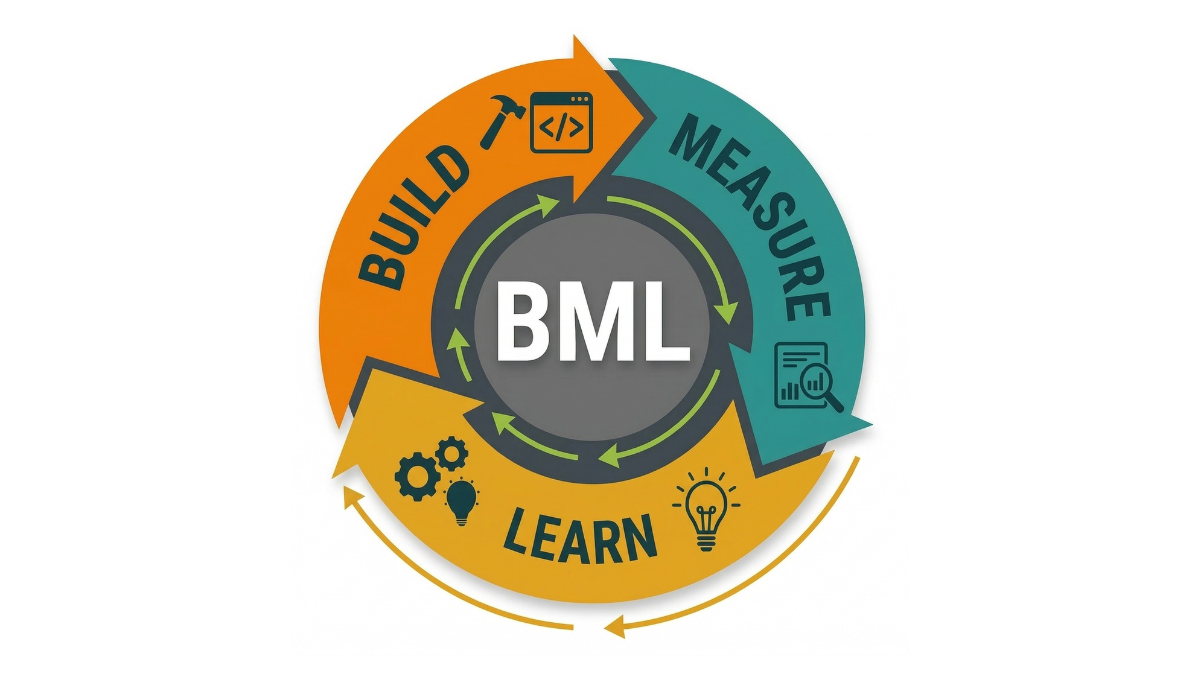
The Lean Startup describes a cycle: Build, Measure, Learn. You build a small thing, measure how people respond, learn from the data, and decide what to do next.
AI accelerates the Build step dramatically. What used to take weeks now takes days or hours. But this only creates value if you also accelerate the Measure and Learn steps.
 The Build-Measure-Learn loop, adapted for AI-assisted product development. AI compresses the Build phase, but Measure and Learn still need human judgment, time, and honesty. Adapted from Eric Ries, The Lean Startup (2011).
In practice, that means:
Before you build, write down your hypothesis. What assumption are you testing? "People will pay for this" is a different experiment from "People can figure out how to use this." Be specific.
Define your measure before you launch. What does success look like? What does failure look like? If you decide this after seeing the data, you're rationalising, not learning.
Set a short timebox. Two weeks, not two quarters. The faster you learn, the less you waste. AI has shortened the Build phase. Shorten the whole cycle to match.
Be willing to throw it away. This is the hardest part. When AI helped you build something quickly, it feels wasteful to discard it. But keeping a product that doesn't solve a real problem is more wasteful than starting again.
MVP vs MMP: Learning vs Earning
There's an important distinction between an MVP and an MMP (Minimum Marketable Product) that gets blurred when building is fast.
An MVP is focused on learning. It's designed to test assumptions and gather feedback from early adopters. It doesn't need to be polished. It doesn't need to generate revenue. It needs to generate insight.
An MMP is focused on delivering value to the broader market. It's the minimum set of features necessary for a product to be marketable and sellable to real customers at scale.
As Jeff Patton puts it:
"The MVP is a way to deliver just enough value to get feedback. The MMP is a way to deliver just enough value to get revenue."
When AI makes building fast, teams tend to skip the MVP and jump straight to the MMP. They build something polished and launch it to the market without ever testing whether the core idea works. This is the classic mistake, just executed more quickly.
The sequence still matters. MVP first, to learn. MMP second, to sell. AI accelerates both steps, but it doesn't eliminate the need for either.
A Practical Framework for AI-Assisted Product Development
The teams getting the most from AI-assisted development are the ones combining fast prototyping with disciplined experimentation. Here's what that looks like:
Use AI to build the experiment, not the product. If your hypothesis is "will freelancers pay for an automated invoicing tool?", don't build the full tool. Build a landing page that describes it and see how many people sign up. AI can generate that landing page in an hour.
Use AI to analyse the feedback. Once you have data from early adopters, use AI to summarise responses, identify patterns, and surface the insights you might miss. This is where AI genuinely helps the learning step, not just the building step.
Use AI to iterate faster. When the feedback tells you to change direction, AI helps you rebuild quickly. The combination of fast learning and fast building creates a tight feedback loop that was impossible when development took months.
Use AI to test multiple hypotheses in parallel. If you can build an MVP in a day, you can test three different approaches in a week. This is a genuine advantage of AI-assisted development, but only if each test has a clear hypothesis and a clear measure.
Conclusion
AI has collapsed the cost of building. It hasn't collapsed the cost of learning. The gap between those two is where most teams are wasting their time right now, building impressive things that nobody needs.
MVP thinking closes that gap. It forces you to start with the question, not the product. To define what you're testing before you build. To measure what actually happens, not what you hoped would happen. And to be willing to change direction when the evidence tells you to.
The teams that succeed won't be the ones that build the most. They'll be the ones that learn the fastest. AI makes both possible. MVP thinking makes sure you do both.
Related reading:
- The PDCA Cycle: Why the Best Teams Learn Faster Than They Plan - the learning cycle behind BML
- The Best AI Strategy Is 200 Years Old - why every technology shift follows the same pattern
References
- Ries, E. (2011). The Lean Startup: How Today's Entrepreneurs Use Continuous Innovation to Create Radically Successful Businesses. Crown Business.
- Blank, S. (2013). "Why the Lean Start-Up Changes Everything." Harvard Business Review.
- Patton, J. (2014). "The Difference Between a Minimum Viable Product and a Minimum Marketable Product." Agile Connection.
- Agile Alliance. "Minimum Viable Product."
Alun Davies-Baker is an agile coach, trainer, and the founder of AltogetherAgile. He helps organisations navigate complexity using empirical approaches grounded in Business Agility.